
Mercury Review 2025: Pros, Cons, & Price Compared


Mercury is here to simplify financial management for startups, regardless of size. They aim to make the journey of building and growing a company hassle-free.
Mercury offers a banking stack free of fees, including business checking and savings accounts. Though not a bank, they collaborate with regulated partners like Choice Financial Group and Evolve Bank & Trust.
These partnerships ensure that users’ finances are secure and managed by reputable institutions. In this article, we’ll dive into Mercury’s reviews and explore the range of features they bring.
>> Explore Mercury’s Features Now! >>
Mercury Review

Mercury is a financial tech company, not your traditional bank. This tech-driven approach makes Mercury a favorite for startups, blending services like venture debt funding with innovative tools like a read-write API, enabling custom banking experiences.
Mercury’s business checking and savings accounts are backed by Evolve Bank & Trust and Choice Financial Group. Your deposits are insured by the Federal Deposit Insurance Corp. up to $5 million, thanks to these partner banks using Insured Cash Sweep networks to spread funds across various institutions.
The star rating in this review is specific to Mercury’s free business checking account, not the entire platform.
This account stands out with no monthly fees, no minimum balance requirements, and no overdraft fees. Beyond these perks, customers enjoy free wire transfers, unlimited virtual debit cards, and discounts on popular business tools, surpassing many online business accounts.
However, Mercury does have some limitations similar to other online banks. It doesn’t accept cash deposits and relies heavily on email for customer support. While some online-only banks use their lower overhead to offer high APYs or cash back on debit purchases, Mercury doesn’t provide these financial perks.
>> Discover the Benefits of Mercury Today! >>
Mercury Is Best for Business Owners Who:
- Possess deposits exceeding $250,000 and seek a sweep account for enhanced FDIC insurance coverage.
- Engage in regular wire transfers, whether sending or receiving.
- Desire access to venture funding opportunities
While Mercury’s business checking account doesn’t earn interest, other options do. For instance, Bluevine Business Checking offers a 2.00% APY on balances up to $250,000 (terms apply) and uses sweep networks to extend FDIC insurance coverage up to $3 million. However, you should be aware that Bluevine charges $15 per domestic wire transfer.
Pros & Cons of Mercury
Pros
- Absence of monthly fees, overdraft charges, or ATM fees
- Seamlessly integrates with third-party apps
- Deposits are FDIC-insured, providing coverage up to $5 million
- API access enables customization of dashboards, sweep rules, and automated mass payments
Cons
- No option for cash deposits
- Savings and checking accounts do not accrue interest
- Requirement of an Employer Identification Number (EIN) for application
Mercury Features
Here’s an overview of Mercury’s offerings.
1. Business Banking Services

Choice Financial Group and Evolve Bank & Trust, both FDIC members, provide the banking services for Mercury, including checking and savings deposits.
With Mercury, you won’t face any account minimums, overdraft fees, monthly fees, or account opening fees when you open a checking or savings account. You can deposit checks, use virtual debit cards, and handle other banking transactions easily.
Additionally, Mercury checking and savings account funds are eligible for up to $5 million in FDIC insurance through sweep networks, a feature Mercury sometimes calls Mercury Vault.
2. Corporate Credit Cards

Alongside debit cards, Mercury offers the IO Mastercard, a business credit card. To qualify, your business needs to maintain at least $25,000 in a Mercury account. The credit limits for the IO Mastercard are based on cash underwriting, meaning changes in your Mercury account balance can affect your limit.
The IO card functions as a charge card, requiring customers to pay off the balance each pay period. Depending on your Mercury account balance, the pay period can be daily or monthly.
3. Mercury Treasury

Mercury offers an investment option through their partner, Apex Clearing Corp, where funds are placed into “lower-risk mutual funds.” This allows startups with over $5 million in deposits to earn a yield on their funds.
However, there are a few important points to keep in mind:
- Withdrawing funds from Mercury Treasury can take several business days
- Money market funds have certain drawbacks compared to directly investing in T-Bills
- The FDIC does not insure Mercury Treasury
- Mercury Treasury is available only to users with account balances over $500,000
- Customers can access mutual funds from Morgan Stanley and Vanguard. These investments are insured by SIPC, not the FDIC
4. Mercury Venture Debt

Mercury provides loans to venture capital-funded companies across various stages and industries. VC firms use venture debt to extend their cash runway with minimal equity dilution. Borrowers can easily request withdrawals and check their remaining capital balance with just a few clicks.
Mercury’s loan agreements permit borrowers to withdraw funds during the interest-only period, which can last up to 18 months. Following this period, firms have up to 48 months to repay the loan.
Additionally, founders can apply to refinance and refresh their loans after raising their next equity round.
5. Financial Workflows and Accounting Integrations

Mercury offers limited integrations with QuickBooks and Xero, along with “Netsuite-friendly reports,” which are essentially CSV exports of transactions for reconciliation purposes. They also provide Bill Pay services linked directly to the Mercury platform.
Their recently launched financial workflows are free to try until August 1st, 2024. After this date, Mercury customers will need to choose one of the following four pricing tiers:
- Core: No monthly fee. No advanced accounting automation for NetSuite. Bill Pay is limited to five bills per month.
- Plus: $35 monthly fee. No advanced accounting automation for NetSuite. Bill Pay is limited to 20 monthly bills, with an additional $2 fee for each extra bill.
- Pro: The $350 monthly fee includes a dedicated relationship manager and advanced accounting automation for NetSuite. Bill Pay is limited to 250 monthly bills, with an additional $1 fee for each extra bill.
- Enterprise: Businesses need to contact a Mercury salesperson for the monthly fee and Bill Pay pricing. This tier includes a dedicated relationship manager.
How Does Mercury Work?
Mercury is a financial technology company partnering with FDIC-insured banks to keep your money safe.
They offer a comprehensive “banking stack” designed to empower startups and simplify banking for all businesses. This stack includes a collection of financial tools and features such as:
- A business checking account
- Business debit cards
- Digital tools and integrations
- Check and ACH payments
- Domestic and international wire transfers
- A business savings account
You can invite as many team members as you need to your Mercury account and control each member’s access level with a three-tier permission system: admin, bookkeeper, and custom access.
This flexibility is great for startups wanting more control over their banking platform and for any business looking to streamline administrative tasks. Mercury debit cards are issued by Choice Financial Group and Evolve Bank & Trust, both FDIC members, under licenses from Mastercard.
How to Apply for a Mercury Account
To apply for a Mercury business account, you’ll need to provide a few key items:
- Your company’s Employer Identification Number (EIN)
- A picture of your government ID
- Your company’s official formation documents
Mercury supports US-incorporated companies, so you don’t need to be physically present in the US or be a resident to open an account.
Mercury Fees
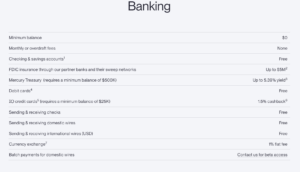
One standout feature of Mercury is its fee-free structure, which receives high praise in reviews.
- No minimum opening deposit
- No minimum balance requirements
- No monthly account fees
- No transaction fees
- No overdraft fees
- Free domestic and international USD wires
Mercury charges only a 1% fee on currency conversions for non-USD currencies and fees for treasury management and mass payments via API. Mercury is perfect for startups aiming to save on banking costs and fees.
Mercury Customer Service
Mercury clients must use email for customer support. Phone support is not offered, chat support is unavailable on weekends, and reviews indicate customers need help with customer support responsiveness.
Mercury Review from Real Users
Trustpilot says 72% of Mercury reviews rate the company as “Excellent,” giving it an overall average rating of 4.0 out of 5. Users particularly highlight its streamlined, user-friendly interface, its suitability for startups, and the efficiency of its email customer support team.
Mercury Alternatives – Mercury Review
[BEST_TRADING_COURSES_SITES]
[FAQ_SECTION]
Bottom Line – Mercury Review
The Mercury Business Checking Account is ideal for growing startups. Its absence of day-to-day banking fees helps keep costs low in the early stages. As your business scales, access to treasury accounts and sweep networks can protect your wealth.
Beyond business checking, Mercury provides resources to boost business growth, including programs for investor networking and peer discussions. Additionally, its integrations with popular business software streamline daily operations, making managing your business more easily.